AI product evaluation means two things: testing whether an AI-powered product works, and using AI models to score software products against each other. Both come down to the same discipline: fixed criteria, repeatable tests and results you can compare. VibeVoted applies the second meaning: 10 distinct AI models score each listed product on seven published criteria, so a buyer or maker sees a side-by-side ranking instead of a popularity contest.
TL;DR
- Evaluation is a set of structured tests tied to what the product must do, not a single score or a generic benchmark (OpenAI).
- Write down the use case, users and success criteria first. Then test on data that looks like your real work.
- AI judges scale well but carry biases such as favoring longer answers, so use rubrics and spot-check against human review.
- Rankings are only as good as their criteria and repeatability. VibeVoted scores on seven fixed criteria using 10 AI models.
- Keep evaluating after launch: products, models and needs change.
Table of Contents
- Two meanings of “AI product evaluation”
- Start with the use case, not the tool
- Build a fair comparison
- Metrics, human review and AI judges
- What a transparent AI ranking measures
- How to read a ranking
- Reducing bias and error
- Keep evaluating after launch
- For product makers: get evaluated
- FAQ
- Sources
Two meanings of “AI product evaluation”
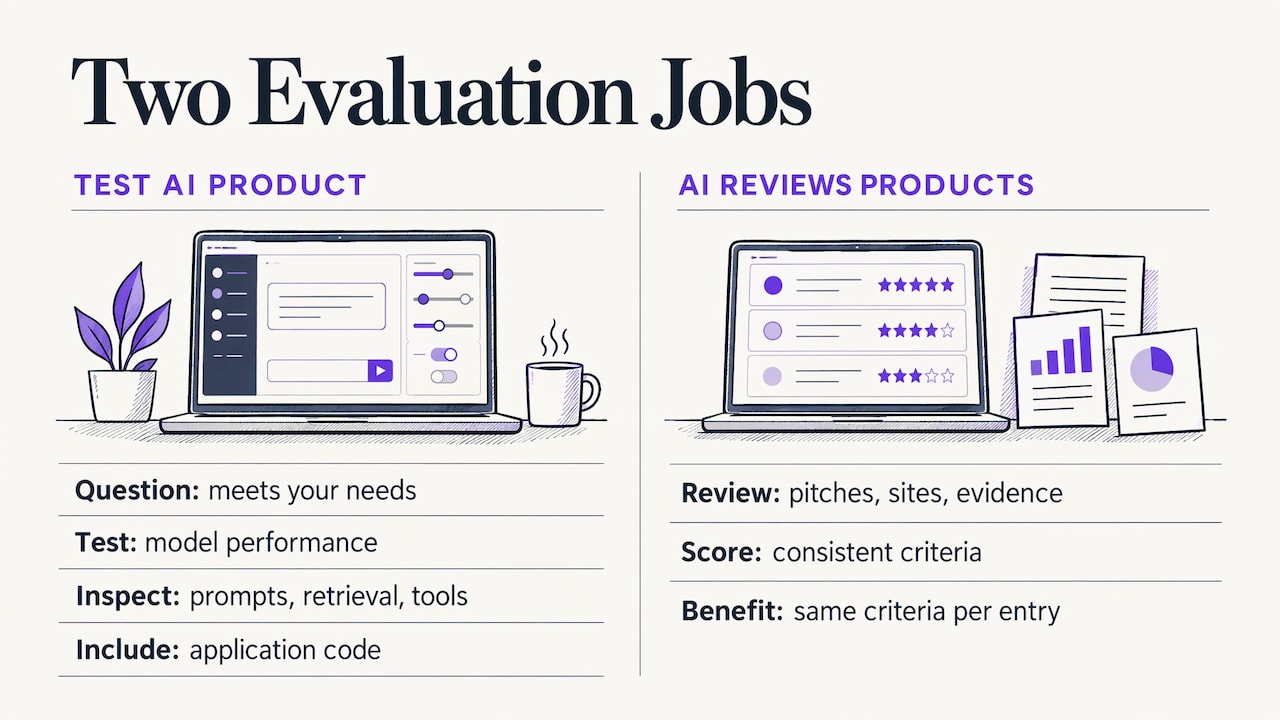
The phrase covers two jobs, and mixing them up is the most common source of confusion.
Evaluating an AI product. You are a team shipping or buying something with AI inside. The question is whether it does what you need. OpenAI describes evals as structured tests of model performance and recommends task-specific evaluations that reflect real-world data, not generic benchmarks alone (OpenAI evaluation best practices). In a real product that covers the model, the prompts, retrieval, tools and the application code around them.
Using AI to evaluate products. Here models act as the reviewers. They read a product’s pitch, site and evidence and score it. This is how a ranking like ours works. The benefit is consistency: the same models apply the same criteria to every entry.
This article covers both, because a good reader of rankings needs to understand how evaluation works underneath.
Start with the use case, not the tool
NIST’s evaluation planning manual starts with context: the sector, the use cases and the target concept you want to measure. It advises balancing the information you want against the complexity of getting it, and writing scenarios that name users, intended outcomes, expected positive and negative impacts and performance indicators (NIST ARIA manual).
For a business buyer that translates into a short written brief:
- Who will use the product, and for what task?
- What does success look like in a number or an observable outcome?
- What failures would be costly, and what do they look like?
- How does the product fit the workflow your team already has?
OpenAI’s business framework adds a practical note: involve a cross-functional team, write the definition of success down, and keep a living set of expert-approved examples. It suggests reviewing 50 to 100 early outputs to spot error patterns (OpenAI). Evals work best as product requirements made measurable.
If the AI feature touches customer-facing campaigns, the same thinking applies to operations around it: how AI changes marketing operations shows why data fit and workflow integration deserve attention before launch.
Build a fair comparison
Comparing two products fairly means giving them the same inputs, the same metrics and the same scoring.
Use representative data
Public benchmarks are a starting point. NIST warns they may be contaminated by training data, and that custom prompt sets built around your use case can be more useful for the decision at hand (NIST). OpenAI notes a test set can mix synthetic, domain-specific, human-curated, production or historical examples, depending on the objective (OpenAI).
Know what a score claims
NIST’s statistical paper separates accuracy on a fixed benchmark from expected accuracy on a broader population of similar items, and stresses stating assumptions and uncertainty (NIST AI 800-3). A product that tops a fixed test has not necessarily proven it will do the same on your data.
Combine fixed tests with exploration
Fixed prompts give scale and repeatability. NIST notes that red teaming and user testing can uncover unanticipated prompts and realistic usage that fixed sets miss (NIST). For security-sensitive products, penetration testing and vulnerability assessments are one example of probing beyond a scripted test.
Metrics, human review and AI judges
No single method is enough. OpenAI’s guide lists the main options and their trade-offs (OpenAI):
| Method | Good for | Watch out for |
|---|---|---|
| Exact or string match, executable checks, function-call accuracy | Tasks with a clear right answer | Misses quality in open-ended output |
| ROUGE/BLEU-style overlap metrics | Summaries, translation | Overlap is not the same as usefulness |
| Human review | Highest-quality judgment | Slow, costly, reviewers may disagree |
| AI judge (LLM as grader) | Scoring at scale, cheaply | Position and verbosity bias |
To get the most from AI judges, OpenAI suggests pairwise comparisons or pass/fail formats, controlling response length, writing detailed rubrics and validating against human labels. Singapore’s IMDA adds that the rubric should match the risk: binary acceptable or not rates suit simple cases, while tiered scales capture severity better (IMDA Starter Kit).
One model’s opinion can lean in a direction. Using several independent models and fixed criteria is a direct way to reduce the effect of any single model’s quirks. That is the design behind our ranking: 10 distinct AI models, the same seven criteria for every product.
What a transparent AI ranking measures
VibeVoted scores each product on seven published criteria:
- Clarity: can a newcomer tell what the product is and does?
- Need: does it address a real problem?
- Differentiation: how does it stand apart from alternatives?
- Evidence: is there proof behind the claims?
- Visual design and polish: does it look and feel finished?
- Trust: does it give reasons to rely on it?
- Sustainability: can it last as a product and business?
Our rankings rest on repeatable AI model evaluations against these fixed criteria, not on user voting or popularity campaigns. Sponsor payments buy exposure and do not influence placement. The full rules are on the rules and methodology page, and the Expert Consilium page shows AI rankings and vote history. You can see how an individual entry reads on pages such as CrownAI or Coool AI, each with model-generated feedback.
How to read a ranking
A ranking is a shortlist tool, not a verdict. Use it like this:
- Filter by category, then read the side-by-side positions.
- Read the feedback, not just the rank. Each entry carries model-generated feedback on strengths and weaknesses. Our guide to using AI-generated feedback on software products explains how to turn it into decisions.
- Match the criteria to your priorities. A regulated team may weigh evidence and trust above visual polish.
- Run your own task test on the two or three finalists with data from your real work, as the guidance above recommends.
For makers, the same criteria work as a checklist. Our piece on validating SaaS product quality with evidence shows how to strengthen the evidence criterion, and SaaS product feedback covers collecting user input alongside model scores.
Reducing bias and error
Bias enters through the data and the setting. The AMA’s AI evaluation guide, written for clinical settings, is a useful model for any team: check whether training and validation data reflect your population and setting, look at subgroup performance, and clarify risks, safeguards, oversight and monitoring (AMA guide). Its performance section asks for metrics suited to the intended function, real-world or prospective validation, and variation across settings.
In practice:
- Test with cases from each user group you serve, not only the average case.
- Include rare but costly edge cases, run in an environment that mirrors real operation (OpenAI).
- Use multiple review rounds and clear scored examples for human raters.
- Keep a team of people who can name recurring errors. Third-party review is one way young AI companies add an outside check.
Keep evaluating after launch
An evaluation is never finished. OpenAI advises running scoped evaluations early and often, continuously on each change, monitoring for new nondeterministic cases, using human feedback to calibrate automated scoring and growing the test set over time (OpenAI). Its business framework adds that evals complement rather than replace A/B tests, and that teams should monitor real inputs and outputs after launch and revise as models, data and goals change (OpenAI).
A leaderboard that re-scores products over time fits that pattern. Our weekly ranking lets you see movement rather than a one-time snapshot.
For product makers: get evaluated
If you build software, a listing puts your product in front of 10 AI model evaluations on seven published criteria, with model-generated feedback for your entry and a place on the category leaderboard. A voting session is 25 USD one-off per credit, and the payment buys exposure, not placement. Start on the sponsor page.

Buyers and researchers never pay: browse the leaderboards on VibeVoted for free.
FAQ
What is the difference between evaluating an AI product and using AI to evaluate products?
The first tests whether an AI-powered product does its job: model, prompts, retrieval and code. The second uses AI models as reviewers to score software against criteria. A ranking like ours is the second kind, and the first kind is what you do on your own data before adopting a tool.
Can AI judges be trusted?
They scale cheaply and give consistent scoring when guided by detailed rubrics, but they can favor longer answers or certain positions. Pairwise or pass/fail formats, length control and validation against human labels reduce those effects (OpenAI). Using several models, as we do, spreads the influence of any one.
How many examples do I need to start?
OpenAI’s business framework suggests reviewing 50 to 100 early outputs to find error patterns, then growing a living set of expert-approved examples (OpenAI). Start small and expand as the product changes.
Do sponsors influence the ranking?
No. Sponsor payments are for entry and exposure only. Placement comes from the AI model evaluations against fixed criteria.
Sources
- OpenAI: Evaluation best practices
- OpenAI: How evals drive the next chapter in AI for businesses
- NIST AI 200-3: ARIA Evaluation Planning Manual
- NIST AI 800-3: Expanding the AI Evaluation Toolbox with Statistical Models
- AMA: AI Evaluation Guide
- Singapore IMDA: Starter Kit for Testing LLM-Based Applications


