SaaS sponsorships run from about $100 for a single newsletter slot to well over $100,000 for a top event package. What you pay depends on the format, the audience and how the seller sets the price. The better question is what each placement costs per qualified lead, because that is the number that tells you whether a quote is fair. For makers who want a fixed, published price for exposure, our own listing is a single credit at 25 USD per voting session, covered below.
TL;DR
- Newsletter slots range from roughly $100 to $2,000 per issue for most lists. Podcast host reads are commonly priced per 1,000 downloads. Events and webinars start in the five figures.
- Sellers price three ways: a flat fee, CPM (cost per 1,000 impressions, opens or downloads) or CPC (cost per click). Bundles often take 10 to 35% off.
- Audience quality moves a fair price more than audience size.
- Compare quotes on cost per lead and cost per opportunity, not on the headline price.
- Our sponsor page lists one voting session at 25 USD per credit, with ranking placement decided by AI model evaluations, not by payment.
Table of Contents
- What a sponsorship fee actually buys
- How sellers set their rates
- The main pricing models
- What placements cost by format
- How to compare quotes
- Measuring whether it paid off
- Before you sign
- A fixed-price way to get ranked exposure
- FAQ
- Sources
What a sponsorship fee actually buys
A sponsorship fee buys access to someone else’s audience, plus the trust that audience places in the publisher. The format decides how much of that you get.
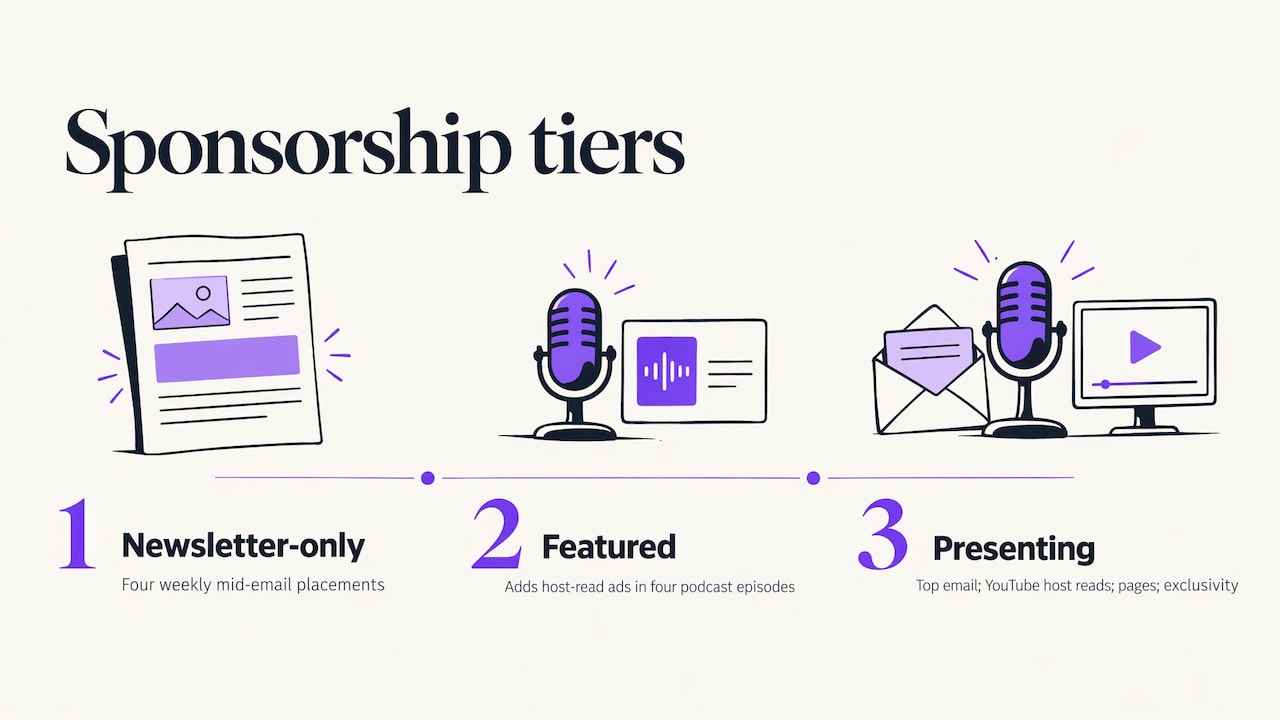
Take one SaaS-focused publisher’s published tiers. A newsletter-only package gives four weekly mid-email placements. A featured package adds host-read ads in four podcast episodes. The top presenting tier adds top-of-email placements, YouTube episodes with permanently embedded host reads, a brand presence on episode pages and category exclusivity. Each step up buys more touchpoints, a better position and protection from rivals.
So when you compare quotes, list what is included: number of placements, position, how long the content stays live, exclusivity, and whether the sponsor gets any reporting.
How sellers set their rates
There is no standard rate card for B2B sponsorship. Publishers and event organizers tend to use one of four methods, as laid out in a January 2025 pricing guide:
- CPM when reach is proven and measurable.
- Value-based pricing when the product is privileged access to buyers.
- Cost recovery for new programs.
- Comparables, pricing near similar offers.
Event organizers often combine two of these. One sponsorship pricing calculator takes the higher of a cost-plus floor ($10,600 of delivery cost times 1.5 is $15,900) and a value-based price ($29,000 of value to the sponsor times a 50% share is $14,500). Another approach prices a package at 15 to 25% of expected sponsor return: 150 leads at $800 each imply $120,000 of value and an $18,000 to $30,000 package.
The lesson for buyers is that a high price is not automatically a bad one. It is a claim about value, and you can test the claim with your own numbers.
Audience quality over audience size
One event-sponsorship guide argues that price should follow audience quality, not size: 300 security leaders with budget authority are worth more to a vendor than 3,000 mixed-title registrants. For a SaaS maker, that means a small developer newsletter can beat a large general one if your buyers are developers.
The main pricing models
| Model | What you pay for | Typical range |
|---|---|---|
| Flat fee per issue or episode | A fixed slot | $50 to $2,000+ per newsletter issue, most common for lists under 20,000 |
| CPM | Each 1,000 opens, sends or downloads | $25 to $75 per 1,000 opens for newsletters; $24 to $40 per 1,000 downloads for podcast host reads |
| CPC | Each click | $2 to $10 per click |
| Hybrid or retainer | Several issues bundled | Often 10 to 20% below buying each separately |
Flat fees dominate among independent newsletters. A June 2026 guide gives the example of $300 on 10,000 subscribers, which is a $30 effective CPM.
Click-based deals are harder to defend. One B2B creator marketplace retired its per-click model in July 2026 because only 62 of 89 completed bookings carried any click event, so billing on clicks could not be measured cleanly.
What placements cost by format
Newsletters
Published rate cards show how wide the range is:
- One marketing newsletter with about 60,000 subscribers lists a resources slot at $100, a primary ad at $400 and a long-form deep dive at $800 per edition, with primary-ad bundles up to 35% cheaper per ad.
- A SaaS founder community newsletter with 5,000+ subscribers and a 40% open rate lists $1,800 per month for four issues on a three-month term, or $2,200 for a single month.
- By list size, one guide benchmarks under 5,000 subscribers at $50 to $200 flat, and 20,000 to 50,000 subscribers at $750 to $2,000.
If you are comparing newsletter prices on a benchmarking page, this overview of operational tooling pricing shows how a SaaS vendor lays out plan tiers, a useful model for how you would structure your own sponsor offer.
Podcasts
Podcast host reads are usually quoted per 1,000 downloads. Business and B2B shows sometimes exceed $40. Many shows do not publish rates at all, so expect to ask for a quote and a minimum spend.
Developer and product directories
Some developer-tool sites sell recurring tiers. One lists $399 per month for a logo on a sponsors page, $1,000 for homepage placement and $2,500 for top placement with direct team access.
Events and webinars
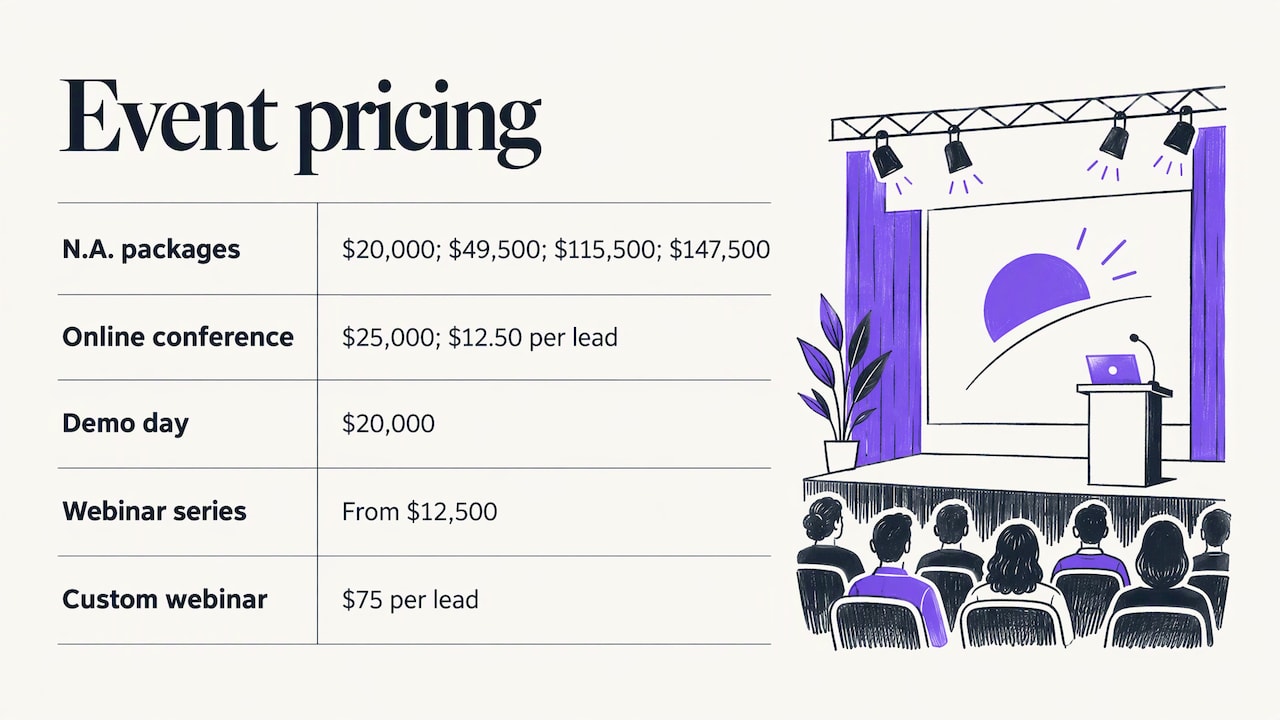
This is where prices jump. A 2026 vendor-conference prospectus lists North American packages at $20,000, $49,500, $115,500 and $147,500. A data-management media kit lists online conferences at $25,000, demo days at $20,000 and hosted webinar series from $12,500. The same kit’s rate card works out to $75 per lead for a custom webinar and $12.50 per lead for an online conference, which shows why the per-lead view matters more than the sticker price.
For in-person events, sponsors also pay for on-site visibility. A guide on digital signage sponsor ad space at events shows how organizers package screens and zones into sponsor inventory.
Marketplace medians
Across one advertising marketplace’s 2026 tech and SaaS listings, median prices were $979 for package deals, $349 for banners and $750 for newsletter placements. Treat these as a sanity check, not a quote.
Old prices
A widely cited SaaS publisher prospectus from 2018 priced a sponsored article at $8,000 and a weekly newsletter sponsorship at $8,000. Those are historical prices, not today’s quotes, so do not use them as a benchmark.
How to compare quotes
- Find the unit behind the CPM. Placement cost is subscribers divided by 1,000 times the CPM, but the denominator can be subscribers, delivered emails, opens or unique clickers, and these are not interchangeable. A $50 CPM on opens costs far more per subscriber than a $50 CPM on sends.
- Set your ceiling from your own channels. Work out what a lead costs you elsewhere. A $60 lead with 30% acceptance is really $200 per accepted lead, so a sponsorship that delivers accepted leads under that figure is competitive.
- Ask for bundle terms. Multi-issue deals commonly take 10 to 35% off the one-off rate.
- Check exclusivity and position. Top-of-email and category exclusivity cost more because they remove competitors from the same slot.
- Ask for past results. Previous sponsor click and lead counts are the best evidence a price is defensible.
- Confirm audience fit. Ask for job titles and company types, not only list size.
Measuring whether it paid off
For each campaign, track cost per lead (spend divided by leads), cost per opportunity (spend divided by opportunities) and pipeline return (attributed pipeline value divided by sponsorship cost), as defined in an October 2026 guide. That guide also cautions against leaning on opens as a core return measure; clicks, site behavior, leads and revenue say more.
A practical setup from a November 2026 attribution guide:
- A distinct UTM link for every placement.
- A short, typeable URL for podcast listeners.
- A record of send date and list size.
- A self-reported “how did you hear about us” field.
- A review about 90 days later, since B2B deals close slowly.
For a wider view of tracking content performance beyond impressions, see this piece on analytics for content marketing.
For a first test, one playbook suggests two publishers, four to six placements each over eight to ten weeks, with a $6,000 to $15,000 budget.
Before you sign
- Get the deliverables in writing: dates, position, format and length.
- Confirm the unit your price is measured in.
- Ask what reporting you will receive and when.
- Agree who writes the copy and who approves it.
- Check whether rivals can appear in the same issue or episode.
A fixed-price way to get ranked exposure
Most sponsorships above leave you guessing about results. Our approach is simpler: software makers sponsor a spot, and one voting session costs 25 USD per credit. Your product is then scored by 10 distinct AI models on seven published criteria: clarity, need, differentiation, evidence, visual design and polish, trust, and sustainability. You receive model-generated feedback on each entry, and products appear on side-by-side leaderboards by category.
Rankings rest on repeatable AI evaluations against fixed criteria, not on user voting or popularity campaigns, and sponsor payments are for exposure only and do not influence placement. You can read the rules and methodology before you decide.

Ready to enter? See the sponsor page. To plan the rest of your distribution, read our practical plan for promoting a SaaS product, or see how directory submission fits alongside paid placements.
FAQ
How much should a small SaaS company budget for sponsorships?
A first test can be modest. Newsletter slots for lists under 5,000 subscribers are benchmarked at $50 to $200, and mid-sized lists at a few hundred dollars. A structured test across two publishers is suggested at $6,000 to $15,000, which is a ceiling for a serious pilot, not a minimum.
Is CPM or a flat fee better?
Flat fees are simple and common for independent newsletters. CPM suits larger audiences with measurable reach. Whichever you choose, convert it to a cost per lead so you can compare.
What is a good cost per lead for a sponsorship?
It depends on your alternatives. Use your own cost per accepted lead from other channels as the ceiling. Published event rate cards show a spread from $12.50 to $75 per lead, so the format matters as much as the publisher.
How long should I wait to judge results?
B2B deals close slowly, so review at about 90 days after the placement, tracking leads, opportunities and revenue by distinct link.
Sources
- Sponsor The SaaS Podcast
- Newsletter Sponsorships, SaaS Club
- Sponsorship Pricing: Formulas + Free Calculator
- Sponsorship Package Pricing Calculator
- How to Price Sponsorship Packages for Events
- Event Sponsorship Packages: Pricing, Tiers, and What to Include
- Sponsorship Package Template Examples & Tools (2026)
- Newsletter Sponsorship Pricing for SaaS Companies 2026
- Creator Partnership Pricing for SaaS: 2026 Rates
- CPC vs Flat Fee: B2B Creator Pricing Models
- Marketing Monk Media Kit
- Developer Tool Sponsorship, SaaS Design
- IT Nation Connect Global Sponsorship Prospectus
- DATAVERSITY Media Kit
- Tech & SaaS Advertising Rates 2026
- Media Sponsorship Packages (2018)
- How to Price Webinar Sponsorships
- B2B Newsletter Sponsorship Pricing: Costs and ROI Guide
- Newsletter sponsorship attribution for B2B pipeline
- Newsletter and Podcast Sponsorships for B2B SaaS Buyers
- Digital signage sponsor ad space at events
- Analytics for Content Marketing
- Opsphere pricing and plans


