
You find the right software by defining the problem before you look at any product, scoring a short list against criteria you set in advance, and testing each finalist on the same real task. The hard part is keeping the comparison honest. Popularity campaigns, paid reviews and polished demos all push you toward the loudest tool. That is why we built VibeVoted: it ranks software using evaluations from 10 distinct AI models on seven published criteria, so you start your shortlist from a repeatable assessment instead of a popularity contest.
TL;DR
- Write down the problem and the one workflow every finalist must handle before you open a single vendor site.
- Split requirements into pass/fail gates and weighted preferences, and set the weights before you score anything.
- Keep the shortlist to two or three tools, then run the same scenario on each.
- Price the full cost over several years, and read the renewal, exit and data-export terms.
- Use a ranking built on fixed, published criteria to build the shortlist, then confirm fit in your own pilot.
Table of Contents
- Start with the problem, not the product
- Turn needs into requirements
- Build a shortlist you can trust
- Score the finalists the same way
- What to check inside each product
- Price the whole life of the tool
- Read the contract and the security terms
- Test with real users on a real task
- Plan for the delay after you choose
- Where VibeVoted fits
- FAQ
- Sources
Start with the problem, not the product
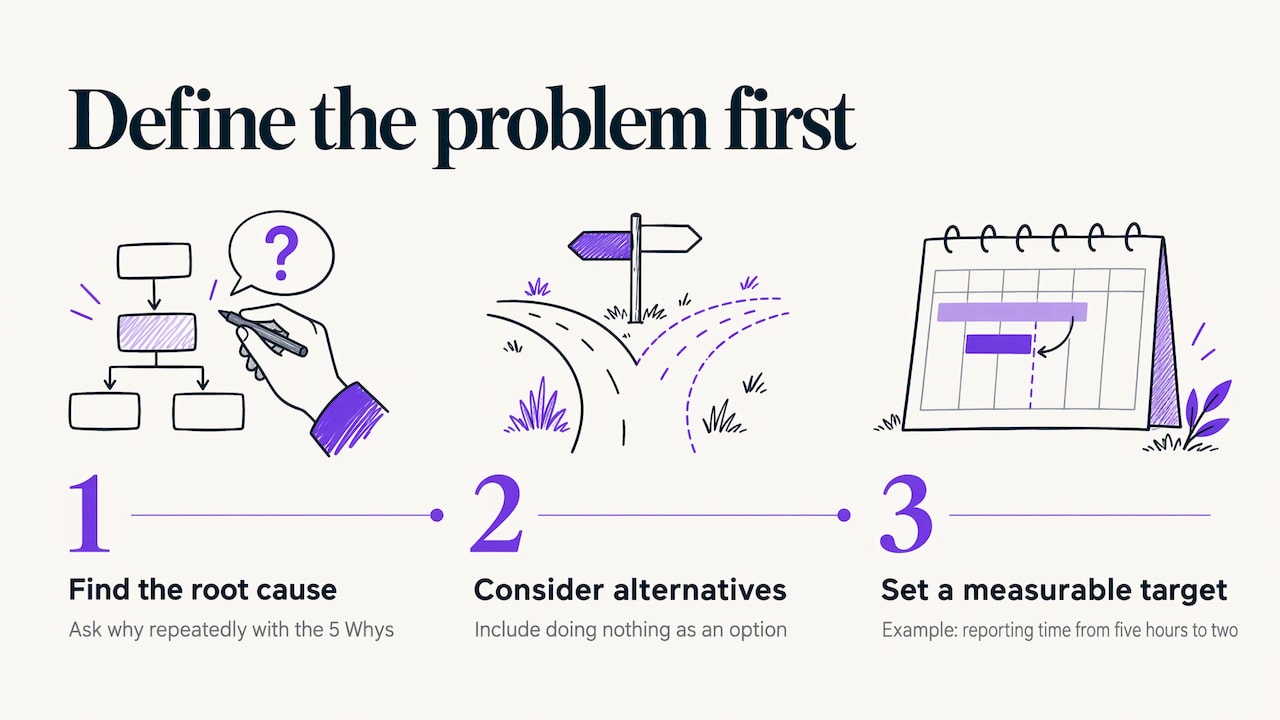
Most bad software purchases begin with a solution in mind. Requirements engineers Karl Wiegers and Candase Hokanson warn that teams often ship exactly what stakeholders asked for, only to see it decommissioned months later because it never solved the right problem. Their fix is root cause analysis with the “5 Whys” (asking why repeatedly until you reach the underlying cause) before committing to any solution.
OpenStax’s information systems text uses the same technique and adds a useful option: consider “do nothing” as one of the possible solutions. If a process fix costs less than a new tool, you want to know that now.
Write a one-paragraph problem statement. Name the business outcome, today’s baseline and the target. Vague goals fail. A measurable one reads like this: reduce weekly reporting time per rep from five hours to two. HubSpot’s procurement checklist recommends exactly this kind of statement before you contact vendors.
Pick one workflow to test everything on
Kintone’s selection guide suggests a one-page decision charter that names the problem, the single workflow every finalist will be tested on, who decides, the budget range, hard constraints and how each stakeholder gives input. That single workflow becomes your yardstick later. Choose the one that hurts most today.
Turn needs into requirements
Requirements come in two kinds. Functional requirements are the features needed for tasks. Nonfunctional requirements are system attributes such as performance, scalability, security and usability, as OpenStax explains. Gather them through interviews, observation, surveys and a look at existing documentation.
Stanford University IT’s evaluation guide advises talking to stakeholders about pain points and keeping two separate lists: essential features and nice-to-haves. Put user experience on the essential list. A tool nobody wants to open delivers nothing.
Gates versus weights
Separate what a tool must have from what you would like. Must-haves are pass/fail gates: a tool that fails one is out, and gates never receive weights. Everything else gets a weight, and the weights total 100%. Kintone’s guide recommends setting these before any demo. Vynara’s decision-matrix guide explains why: weights chosen after you see the scores invite the team to quietly favor the option it already likes.
A sample weighting from Apptimate’s ERP scorecard shows the shape: process fit 35%, finance and controls 20%, daily usability 15%, data and integrations 10%, delivery and support 10%, total cost 10%. Yours will differ, but the exercise of forcing trade-offs is the point.
Build a shortlist you can trust
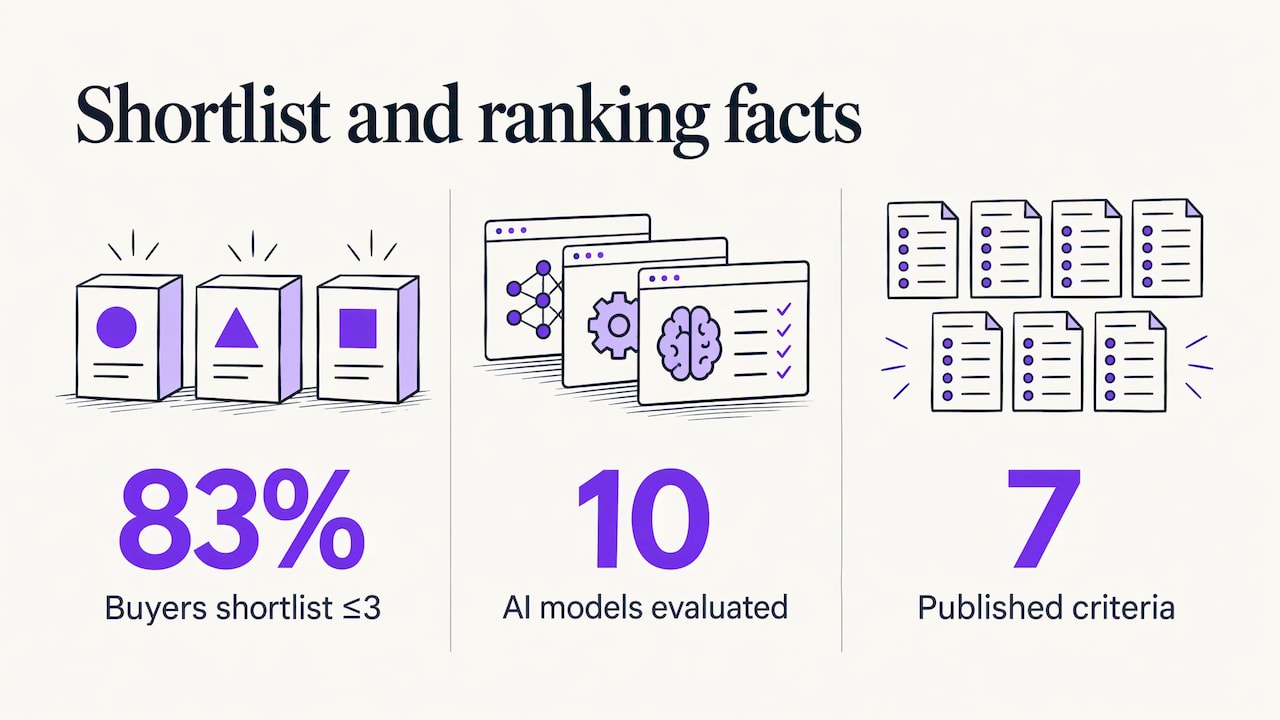
The shortlist is where bias creeps in. Search results, sponsored placements and review sites that reward volume of votes all favor tools with big marketing budgets. Keep the list short: TrustRadius’ 2026 survey, as summarized by KeenVerdict, found 83% of technology buyers shortlisted three or fewer products.
A ranking helps most when its method is fixed and visible. VibeVoted’s leaderboards are built on evaluations from 10 distinct AI models, scored on seven published criteria: clarity, need, differentiation, evidence, visual design and polish, trust, and sustainability. Rankings rest on repeatable model evaluations, not on user voting or popularity campaigns, and sponsor payments buy exposure without influencing placement. You can read the full approach on the rules and methodology page and browse the weekly ranking by category to see products side by side, each with model-generated feedback.
If you want more depth on discovery, our guide to SaaS product discovery walks through finding, validating and shortlisting tools.
Score the finalists the same way
A scorecard works when every vendor faces the same questions. HubSpot’s framework scores each vendor on seven criteria (business outcomes, usability, integrations, security, scalability, vendor support and AI readiness) on a 1 to 5 scale, with an evidence note for every score: a documentation link, a demo timestamp or a reference quote.
Some rules keep the numbers honest, drawn from Kintone’s rubric:
- Mark untested criteria “unproven” rather than zero or pass.
- Have reviewers score independently before discussing disagreements.
- Never let a small numerical gap alone decide the winner.
Vynara adds a sensitivity check. If shifting a weight by five points flips the winner, you are not sure yet, and a pilot or reference check should settle it. Apptimate makes the same point from another angle: a scorecard exists to expose trade-offs, and a high total should not hide a failed requirement that stops the business operating.
For a fuller walkthrough, see our software evaluation framework and the guide on how to assess software quality.
What to check inside each product
The Malaysian Institute of Accountants’ guidance on software and vendor selection lists practical factors worth borrowing, whatever your industry:
- Current, future and frequently used features
- Fit with your existing equipment and IT strategy
- Integration with the tools you already run
- Data import and export
- Reporting
- Compliance and timely regulatory updates
- Support and training
It also recommends choosing software that can handle projected transaction growth for at least the next three years. That is the simplest scalability test: write down where volume will be in three years and ask whether the tool copes.
Price the whole life of the tool
The sticker price is rarely the real one. Stanford’s guide tells buyers to budget for annual cost increases, which can range from 5% to 25% or more depending on the vendor. SMC Consulting defines total cost of ownership as licensing plus implementation, configuration, training, administration, customization, integration and upgrades across the platform’s life, and suggests asking for a three- to five-year estimate.
Thoughtworks adds that the buyer should own the cost and return model because package pricing can obscure true costs. Keep one-time and recurring costs in separate lines, and include internal staff time, which is the category most often left out. If you want a starting template, an AI automation ROI calculator can help you structure the return side.
Read the contract and the security terms
Before you sign, ICAEW’s checklist for implementing software points to terms that matter later: trial periods, notice periods, automatic renewals, the risk of price increases mid-contract, service-level details, and termination rights including read-only access to your data. It also asks you to confirm that data can be exported in usable formats such as CSV, JSON or via an API, and that security controls include encryption, multi-factor authentication, single sign-on and audit logs.
Thoughtworks flags missing standards-based single sign-on as a common security showstopper, and recommends classifying your data sensitivity first, then asking the vendor for its security attestations such as SOC 2 Type 2 reports. Our software procurement process guide covers these steps from need to renewal.
Test with real users on a real task
A polished demo proves little. Vynara warns that a demo is not evidence a tool will work in your operation. Run every finalist through the same scenario. IBM’s selection article recommends “day-in-the-life” scenarios, no more than two or three vendors, and hands-on evaluation by all significant decision makers.
TechTarget’s pilot guide adds the structure: a named sponsor who secures budget, success metrics set before the pilot begins, users from each affected department plus IT staff to test interoperability, training, and feedback gathered throughout. Validate the final recommendation against those original metrics.
Who to involve
Leaving out a legitimate stakeholder is riskier than including one too many, according to Carnegie Mellon’s Software Engineering Institute, which also suggests keeping the core group to about seven or eight people. HubSpot’s framework notes that conflicting goals and inconsistent requirements are leading causes of project delay and abandonment, so get a signed agreement on what success looks like within 90 days, the number that shows it, and who is responsible.
Check references
Ask finalists for two or three customer references with a similar business model. Arena Solutions also treats a vendor who says yes to nearly every requirement as a red flag.
Plan for the delay after you choose
Selection does not end the process. In G2’s June 2026 survey of 1,038 B2B software buyers, IT security review was the most cited post-selection delay at 39%, ahead of budget approval at 32% and implementation planning at 25%. Start the security review while you pilot, not after.
Where VibeVoted fits
If you buy software, VibeVoted gives you a free, category-based starting point: side-by-side leaderboards, scores on seven fixed criteria and model-generated feedback on each product. It costs you nothing to use. Our guides on business software decisions and the software selection process pair well with it.
If you make software, a place on the leaderboard puts your product in front of exactly these buyers. One voting session is 25 USD one-off per credit, and you can enter yours on the sponsor page. Sponsorship pays for exposure and entry, and it does not influence placement.

FAQ
How many software options should I compare?
Two or three finalists is the practical limit. IBM recommends reducing to two or three vendors for scenario workshops, and TrustRadius found most buyers shortlist three or fewer. More than that dilutes the testing you can do on each.
Should I set weights before or after seeing the demos?
Before. Weights set after you see scores let the team favor the option it already prefers. Agree gates and weights with stakeholders first, then score every vendor on the same scenario.
What does software really cost over time?
More than the license. Include implementation, training, integration, administration and upgrades, and budget for renewal increases that Stanford says can run from 5% to 25% or more. Ask vendors for a three- to five-year estimate and keep one-time and recurring costs separate.
Can I rely on rankings to pick software?
Use them to build the shortlist, then confirm fit yourself. A ranking with fixed, published criteria, like VibeVoted’s seven, tells you which products deserve a pilot. Your own test on one real workflow makes the final call.
Sources
- Laying the Foundation of Requirements Engineering (InformIT)
- Defining the Business Problem and User Requirements (OpenStax)
- Software procurement checklist (HubSpot)
- How to Evaluate Workflow Software (Kintone)
- Software Evaluation Guide (Stanford University IT)
- Decision Matrix Template (Vynara)
- ERP Comparison Scorecard (Apptimate)
- Software Buying Statistics 2026 (KeenVerdict)
- Enterprise software evaluation framework (HubSpot)
- Guidance on Software and Software Vendor Selection (MIA)
- ITSM Vendor Evaluation Criteria (SMC Consulting)
- Build versus buy (Thoughtworks)
- Checklist for implementing software solutions (ICAEW)
- The hidden best step in selecting planning software (IBM)
- How to run a successful IT pilot program (TechTarget)
- A Process for COTS Software Product Evaluation (Carnegie Mellon SEI)
- How to Buy the Right Software (Arena Solutions)
- AI automation ROI calculator (Brainiac)


